

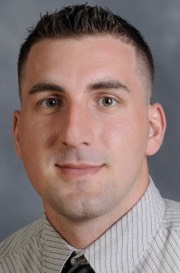
We have a special treat leading into the 2013 NCAA Fencing Championship, as former Penn State great Aleks Ochoki has sent along his observations and predictions – penned during the long flight to Moscow (Russia, not Idaho), no less, for an upcoming World Cup. Ochocki won the NCAA sabre title in 2009, edging fellow freshman and 2012 U.S. Olympian Daryl Homer in a 15-14 classic, and he closed his career with a second title in 2012 (over former Harvard fencer Valentin Staller). Ochocki, who spent this season as an assistant coach at Steevns Tech, remains active at international competitions and currently is the 7th-ranked U.S. men's sabre fencer. …
2009 Men's-Sabre Final
Daryl Homer/StJ vs. Aleks Ochocki/PSU; photos+video hybrid, from CF360
__________________________________
My observations and predictions for the 2013 NCAA men's sabre competition
by Aleks Ochocki
The NCAA fencing championships is one of the rare collegiate championship where every competitor tests their skills against everyone in their field. The field is set and the regular season stats don't matter anymore, every point could decide each fencer's chances on the possibility to be crowned NCAA champion (and, in some cases, to help win the team title).
The two-day tournament forces these student-athletes to not only test their physical abilities but more importantly their mental ability. The hardest part of the tournament is being able to keep your intensity for 23 five-touch bouts. Almost an impossible feat in going undefeated into the Final Four (semifinals), fencers are tested on their ability to quickly bounce back after losing a bout.
With no home-field advantage this year (compared to recent years at Penn State, Harvard and Ohio State) since the championships are going to be held in San Antonio, and with some new additions in the field, don't be surprised if the Final Four in all three weapons is filled with some new faces.
The men's sabre competition is filled to the top with strong fencers. Besides the clear favorite Daryl Homer (St. John's), the 2010 and '11 NCAA champ, the remaining three spots are up for grabs. Homer, a 2012 Olympian and currently ranked #8 in the world, should get his third title. Although Daryl is the clear favorite and is a head above the competition, he likely will drop several bouts throughout the two days. Since the round-robin is only 5-touch bouts, it gives fencers the opportunity that – if they come in with a solid gameplan and are ready to physically move – then anything can happen. Daryl's strengths come into play in the medal round (Final Four/semifinals), where the bouts are 15 points and even include breaks when fencers can chat briefly with their coaches. These longer bouts are where Homer's experience, along with his game plans, will be on display. His footwork alone is enough to secure him the title.
In my opinion, another Final Four entry will be filled by Penn State freshmen Shaul Gordon. Gordon won the Mid-Atlantic Regional and was the #3 national seed prior to the Regional. The upside to the freshaen with little experience is his hunger. From speaking to Penn State assistant and saber coach Wes Glon, Shaul is one of the hardest workers and gives everything he has at practice. The reason I list that as an asset for the championship is because the desire and the ability to "grind out" touches is crucial. Many bouts will go 5-4 and that crucial desire is necessary to deliver that final touch that makes the difference between a win and a loss. Gordon's unorthodox style and quickness will be uncomfortable for most fencers. Once again, five points is not always time enough to figure out and get acquainted with your opponent.
My next Final Four prediction is Ohio State's Canadian National Team member Max Stearns. Max was a semifinalist last year and is the Midwest Regional champion each of the past two tears. He is built for the NCAA format, boasting a warrior mentality along with great speed and reactions ... he is bound to end up in the Final Four. My only concern with Stearns is his lack of a traveling teammate. This year at the NCAAs, athletes are paired with three additional "traveling" partners [the format is different from past years, when there were eight groups of three; this year it's six groups of four] and if your teammate also is in the field he will be in the same group with you. Stearns is a guy driven by the crowd and feeding off his teammates. The lack of a crowd and no traveling teammates causes a small doubt in my mind, but knowing Ohio State coach Nazlymov's intensity, I think Max will make the Final Four.
My last Final Four empty slot is up for grabs. This should be an interesting race amongst the boards. My gut feeling is that Penn State junior Adrian Bak will fill the spot. This decision has nothing to do with favoritism towards my alma mater. Adrian has had a solid season performance and went into the Mid-Atlantic Regionals seeded first. Adrian missed last year's Final Four based on indicators ... this is why I said every point counts. Adrian is the Penn State captain and I think his experience with this tournament will finally come full circle if his ankle injury is fully healed. Additionally, having Shaul Gordon win some bouts will help Bak's momentum throughout the days. My only skepticism due to being Adrian's teammate is that Gordon's quiet nature and lack of verbal emotions will not work in Bak's favor. One other intangible for Adrian is the fencing tradition in his family – his brother Daniel was my teammate and reached the NCAA final a couple years back (a loss to Homer, in 2010).
My two fencers to watch and who have a solid chance of also making the Final Four are two lefties: Columbia's Will Spear and UPenn's Evan Prochniak. Spear, whose brother Jeff won the 2008 NCAA sabre title and was a 2012 Olympian, does not come into the 2013 tournament with a high seeding but – make no mistake about it – he is a "silent killer." Will has enough experience and skills that, if he decides to show up ready for war, he will cause a lot of problems for people. Prochniak was an NCAA finalist in 2011 (another loss to Homer) and he knows what it takes to get there and how to win. Being on the National Team with Evan and seeing the way he dominated pools was something else. He has talents and all the tools needed. One key factor for him could be good control of his feelings and taking accountability for his performance … he could ended up pushing one of the other guys out of the finals.
Another two great student-athletes who will be fighting for All-America honors and positions in the top-8 are Sean Buckley (St. John's) and Michael Josephs (Columbia). Sean's season static's are phenomenal and he has proven he can get the job done. Buckley, also a Junior National Team member, is a fighter but I think his lack of ability to bounce back from a loss and squeeze out the close 5-4 bouts could cause him to lose a close battle for the Final Four. In past years at the NCAAs, those have been my observations about Sean but if he figures out his mental game, then he will definitely prove me wrong. Josephs gives me the same concerns, although fast and in good physical shape, his mental ability to recover from a defeat will be his biggest challenge.
One thing is for sure: the 2013 NCAA Fencing Championships will add to all of the March Madness. The sabre event will be a hard-fought tournament that will test every student-athlete's mind and body. The strong field will be exciting to watch and see if someone can create their Cinderella story come Friday.
– Aleks Ochoki